
Are you looking to find out detailed information on factors leading to a broken supply chain and ways to fix it? In this article, Hospaccx Healthcare Consultancy has mapped all on major aspects of Hospital Disaster Preparedness.
INTRODUCTION
The healthcare supply chain refers to the complex network of activities, processes, and resources involved in the procurement, storage, and distribution of healthcare products, equipment, and services. It includes the movement of drugs, equipment, information, and medical supplies from producers and suppliers to healthcare facilities like hospitals, clinics, and pharmacies.
The availability of important healthcare goods and services when and when they are required is crucially dependent on the healthcare supply chain. Numerous parties are involved, including producers, retailers, wholesalers, medical facilities, regulatory bodies, and logistical companies. These parties cooperate to ensure the prompt and effective delivery of medical supplies while upholding standards for quality, safety, and regulatory compliance.
A crucial part of the healthcare sector, the healthcare supply chain is currently dealing with major difficulties that have shown its underlying fragility. The flow of medical supplies, equipment, and services from suppliers to healthcare facilities has been hampered and disturbed, which has led to shortages, inefficiencies, and subpar patient care. This urgent matter necessitates prompt notice and corrective action.
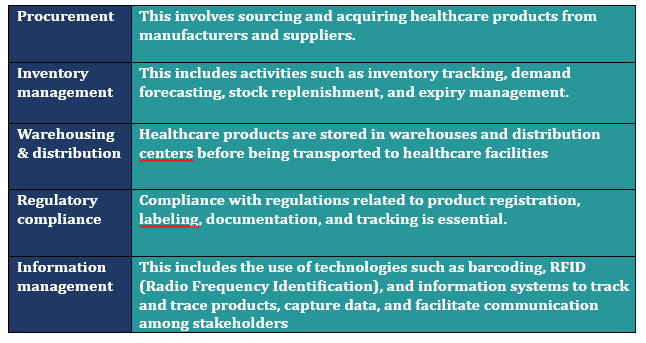
KEY COMPONENTS AND PROCESSES OF THE SUPPLY CHAIN
REASONS BEHIND BROKEN SUPPLY CHAIN
The healthcare facility supply chain has been under significant strain and has faced challenges that have contributed to its perceived brokenness. Here are some reasons why the healthcare facility supply chain may be considered broken:
- Lack of coordination and visibility: The healthcare supply chain encompasses a wide range of parties, including producers, retailers, hospitals, and regulatory organisations. These various organisations frequently lack communication and visibility, which causes inefficiencies and delays in the supply chain. This may make it challenging to effectively estimate and meet demand.
a.Gaps in communication:
- A successful supply chain depends on effective communication. Manufacturers, distributors, healthcare facilities, and regulatory authorities frequently lack effective communication routes with one another in healthcare supply chains.
- In crucial procedures like order placement, shipping tracking, and inventory management, this may result in delays and misunderstandings.
- It can be difficult to respond quickly to changes in demand or deal with supply chain interruptions when communication is ineffective since it can lead to inaccurate or delayed information flow.
b.Limited visibility:
- Lack of visibility refers to the inability to track and monitor the movement of products and information throughout the supply chain.
- Without a comprehensive view of inventory levels, shipment status, and demand patterns, it becomes difficult for stakeholders to make informed decisions. Limited visibility can result in overstocking or understocking of essential supplies, leading to either wastage or shortages.
- It also hampers the ability to identify bottlenecks or inefficiencies within the supply chain and take corrective actions.
c.Inaccurate demand forecasting:
- Effective supply chain management depends on accurate demand forecasting. However, it might be difficult to collect precise data for demand forecasting when there is a lack of collaboration and visibility across stakeholders.
d.Difficulty in meeting surge demands:
- During emergencies or unexpected events, such as natural disasters or pandemics, healthcare supply chains face sudden surges in demand for specific medical products.
- Without proper coordination and visibility, it becomes challenging to rapidly adjust production, distribution, and inventory management to meet the increased demand.
e.Inefficiencies and delays:
- When there is a lack of coordination and visibility, supply chain processes can become inefficient and prone to delays.
- For example, if healthcare facilities cannot communicate their specific needs accurately, manufacturers may produce and distribute generic or non-essential products instead of prioritizing critical items.
- Fragmented systems: Systems that are not fully integrated or standardised make up the majority of healthcare supply chains. This could result in labor-intensive manual procedures, a reliance on paper-based solutions, and a lack of interoperability between various healthcare organizations. The coordination and flow of information might be hampered by the absence of standardized data formats and communication protocols.
- Lack of contingency planning: Many healthcare facilities and supply chain organisations did not have effective backup plans in place to handle unforeseen disruptions. Failures in the supply chain and challenges in maintaining adequate supplies might result from a lack of readiness for major events or unexpected surges in demand.
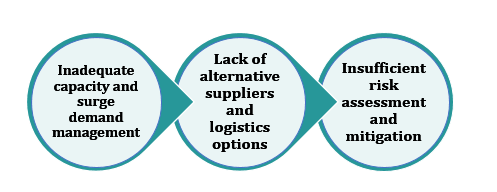
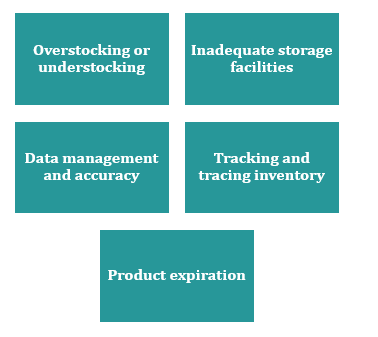
4.Inventory management challenges: Healthcare facilities face challenges in managing their inventory effectively. These challenges include overstocking or understocking essential supplies, inadequate storage facilities, expiration of products, and difficulties in tracking and tracing inventory. Poor inventory management can lead to wastage, increased costs, and delays in accessing critical supplies.
5. Cost pressures: Healthcare facilities often face financial pressures, and supply chain management can become a cost-cutting target. This can result in reduced investment in supply chain infrastructure, inadequate staffing, and limited adoption of technological advancements. Insufficient resources can hamper the efficiency and resilience of the supply chain.
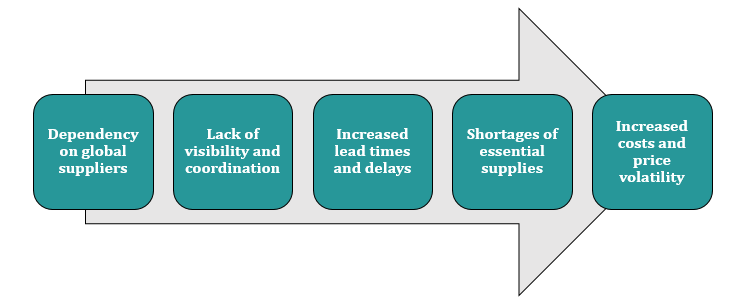
6. Global Supply Chain: Global supply chain disruptions can have a significant impact on the healthcare supply chain, leading to a broken or dysfunctional state.
I am text block. Click edit button to change this text. Lorem ipsum dolor sit amet, consectetur adipiscing elit. Ut elit tellus, luctus nec ullamcorper mattis, pulvinar dapibus leo.