
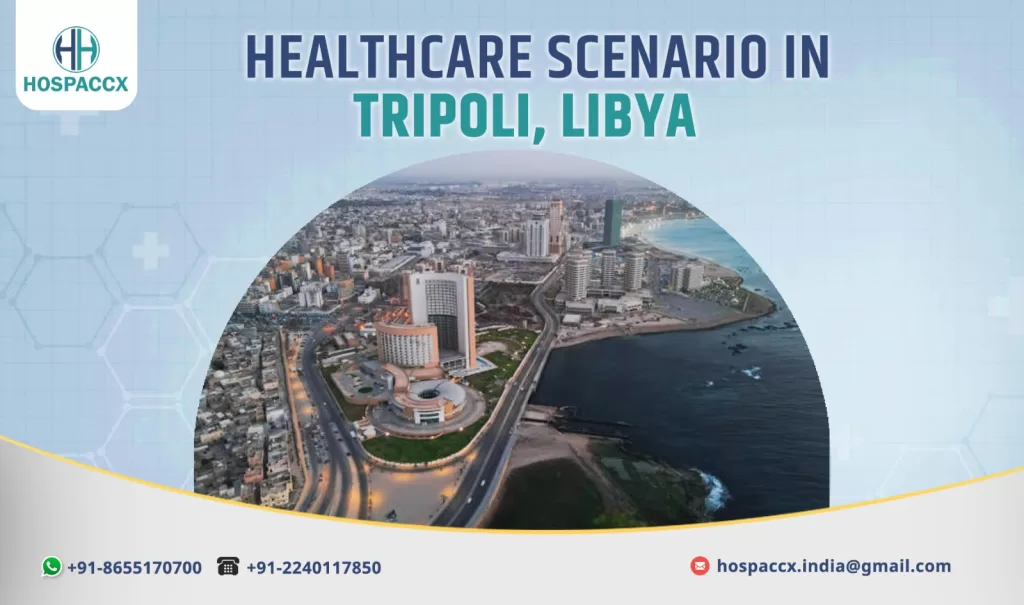
Tripoli
Tripoli, the capital city of Libya, stands as a testament to the nation’s rich history and its ongoing endeavors toward modernization. Situated along the Mediterranean coast, Tripoli serves as Libya’s largest city and its principal seaport, acting as a central hub for the country’s economic, cultural, and political activities. located in the northwestern part of the country along the Mediterranean coast. Today, it is home to key government institutions, universities, and major businesses. Tripoli, the capital and largest city of Libya, has experienced steady population growth over the decades. In 2024, the estimated population is 1,192,440. The total surface area is 1,507 km².
Healthcare Scenario
Tripoli, Libya’s capital, has faced significant challenges in its healthcare sector, primarily due to prolonged conflict and political instability. The decade-long conflict has left the healthcare system on the verge of collapse, with an estimated 1.3 million people in need of humanitarian assistance. The healthcare infrastructure in Tripoli comprises primary healthcare units, centers, polyclinics, rehabilitation centers, and general hospitals. Major hospitals, such as Tripoli Central Hospital, serve as key medical facilities in the city.
In early January 2025, Tripoli University Hospital successfully performed 12 brain catheterization operations over two days, marking a notable advancement in the city’s neurosurgical capabilities.
Healthcare Infrastructure
The protracted conflicts have left Tripoli’s healthcare infrastructure in a state of disrepair. Many medical facilities suffered damage or destruction, leading to a reduction in operational healthcare centers. The lack of maintenance and modernization has further impeded the delivery of quality healthcare services. Efforts are underway to rebuild and equip hospitals and clinics; however, progress is hampered by ongoing political and economic challenges.
List of Hospitals
| Hospital | Type |
| Tripoli Central Hospital | Public |
| 11 June Hospital | Public |
| Abu Slim Hospital | Public |
| Tripoli Medical Centre | Public |
| Tripoli Eyes Hospital | Public |
| Jalaa Maternity Hospital | Public |
| Razi Psychiatric Hospital | Public |
| Metiga Military Hospital | Public |
| Albushra Clinic | Private |
| Alaasema Clinic | Private |
| Alamane Heart Clinic | Private |
| Al Mokhtar Clinic | Private |
| Libya Swiss Medical Clinic | Private |
| Ain Al Hayat Hospital | Private |
| Al Khadra Hospital | Private |
| Saint James Clinic | Private |
| Medilink International | Private |
List of Diagnostic Centres
- Ibyan Swiss Diagnostic Center
- Attasami Diagnostic Service
Institution Providing Medical Education
- University of Tripoli – Faculty of Medicine
Established in 1973, the Faculty of Medicine at the University of Tripoli is one of Libya’s pioneering medical schools. It offers a comprehensive medical curriculum leading to the MBBCh (Bachelor of Medicine, Bachelor of Surgery) degree. The faculty boasts over 493 members, primarily nationals who have significantly contributed to healthcare services across the country.
- International Maaref University – Faculty of Human Medicine
Founded in 2022, the International Maaref University is a private institution in Tripoli. It adopts an advanced international educational system aimed at preparing graduates with extensive knowledge, high skills, and professionalism. The university emphasizes providing high-quality and safe medical services, addressing both national and global healthcare needs.
- Al-Tahadi National Medical University
Al-Tahadi National Medical University is a private, for-profit higher education institution located in Tripoli. Officially recognized by the Ministry of Higher Education and Scientific Research of Libya, it offers coeducational medical education programs.
Conclusion
Tripoli’s healthcare system stands at a crossroads, confronting the dual challenges of rebuilding after years of conflict and addressing systemic deficiencies. While efforts are underway to reconstruct infrastructure and enhance service delivery, substantial work remains to establish a resilient and equitable healthcare system. Addressing workforce shortages, ensuring consistent supply chains for medical necessities, and fostering international collaborations for medical tourism are pivotal steps toward achieving sustainable healthcare improvements in Tripoli.